North to South
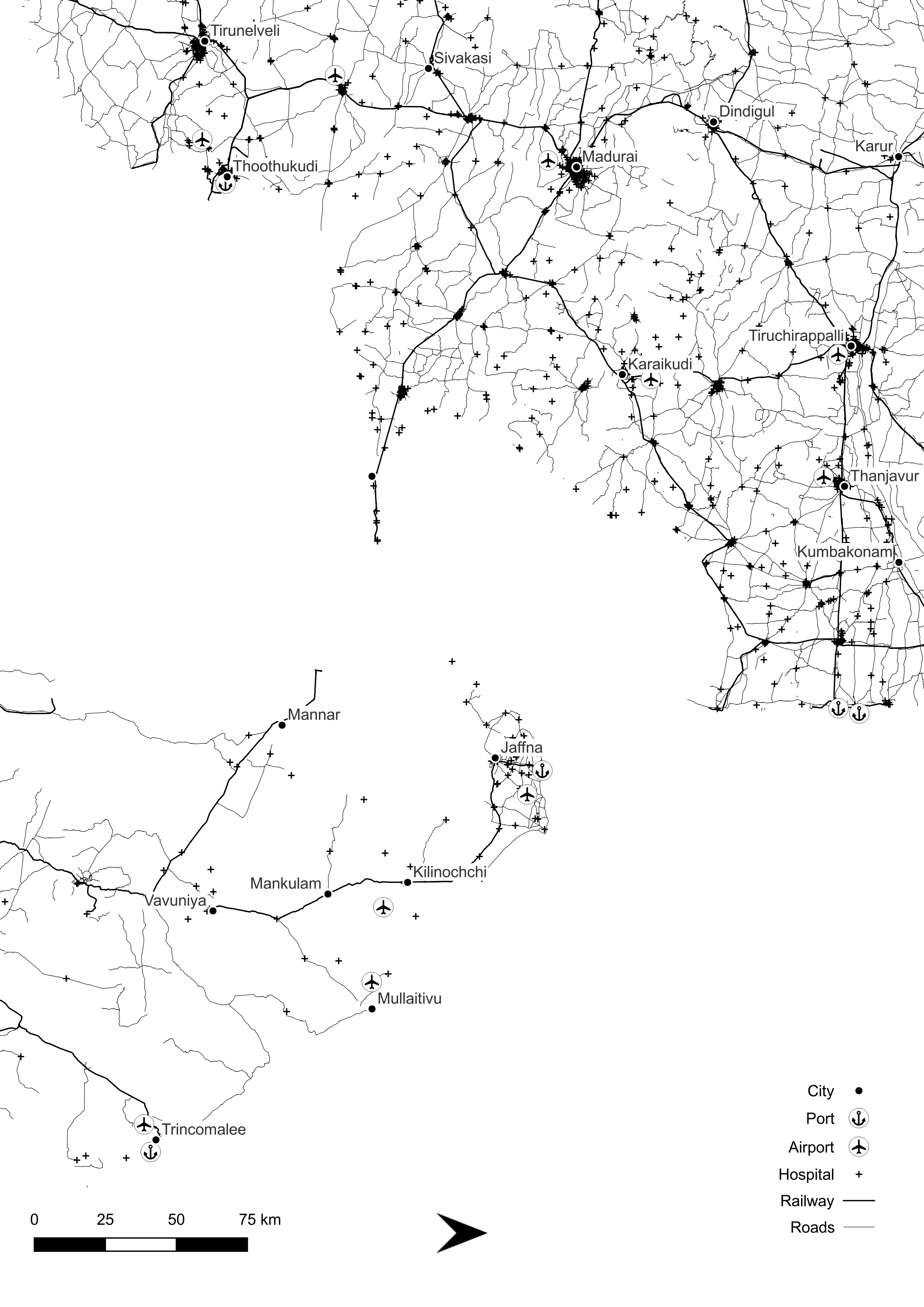
Jaffna and Tiruchirappalli (known colloquially as Trichy) are roughly separated by a mere 190 kilometres. In fact, Jaffna is closer to Trichy than it is to Colombo. It is an unspoken truth that much of the Tamil-majority North-East, from Mannar to Trincomalee, is geographically closer to Tamil Nadu than it is to much of southern Sri Lanka. With their proximity and their large Tamil populations, Jaffna and Trichy seem like obvious candidates for some kind of transit service between them. Indeed, they had been connected by air travel as early as the 1950s, when Air Ceylon operated flights between Colombo and Trichy via Jaffna. That service would be discontinued in the 1970s, as the Sri Lankan state sought to sever ties between the North-East and Tamil Nadu during the intensification of the ethnic conflict in the lead-up to the armed Tamil liberation struggle. In the process, trade and travel across the Palk Strait, which had been a fact of life for perhaps thousands of years, was disrupted.
Instead, someone who wished to make that same trip would have to first travel south from Jaffna to Colombo by bus, hired vehicle, or train – adding an extra 350 kilometres and around seven hours at a minimum – before departing from Bandaranaike International Airport and flying back north towards Tamil Nadu. This kind of circuitous journey is all too familiar to anyone who has travelled internationally either from or to the North-East, whether they are local residents, members of the diaspora, or simply just interested travellers. Such was the state of things until March 2025, when the Indian airline IndiGo commenced daily flights between Jaffna and Trichy. A journey that had previously spanned more than 800 kilometres and took more than half a day was cut down to an approximately hour-long flight.
A Changing Landscape
Trichy became Jaffna International Airport’s second daily flight service after Chennai, which began when the Sri Lankan government reopened the airport in 2019 with Indian assistance. However, when the airport was reopened, initially connections seemed to be planned to four Indian cities, all of which were outside of Tamil Nadu: Bengaluru, Hyderabad, Kochi, and Mumbai. Chennai appeared to be excluded in what seemed to be an attempt to both protect the income of Bandaranaike Airport and keep the North-East from directly connecting internationally, reinforcing the view that development projects in the North-East are tools meant to further the hegemony of the south. The government, presumably after some stern words from Delhi, later announced that there would, in fact, be flights to Chennai.
It should not have been surprising that such ploys were attempted, given the hostility from southern Sri Lanka to the notion of the North-East having any connection to Tamil Nadu that is not mediated, if not outright controlled, by the south. But in the aftermath of Sri Lanka’s 2022 economic crisis and in the midst of an evolving global order, things have moved in a different direction. Sri Lanka’s precarious economic position, along with India’s desire to enlarge its footprint on the island, has increasingly put connectivity at the forefront of relations between the two countries. Among the many proposals to increase cultural, economic, energy, and transportation connectivity, the two governments have pledged to further develop the Jaffna airport. Construction is said to have begun on a new passenger terminal, while plans to expand the runway to help accommodate larger aircraft are apparently under consideration.
Undoubtedly, this has also in part been contributed to by the Tamil diaspora, who now have a more direct journey to the Tamil homeland available to them, with the option to make a stopover in Tamil Nadu along the way. Given this success and the overall circumstances, it is reasonable to contemplate the course of things had his potential been tapped sooner, and how much more remains unrealised.
For its part, Jaffna International Airport is showing results, reportedly seeing 53,443 passenger movements in 2025. These numbers are all the more impressive considering that they were largely achieved by the two daily flights to and from Tamil Nadu, which are serviced by relatively small, turboprop aircraft that seat around seventy to eighty passengers. Undoubtedly, this has also in part been contributed to by the Tamil diaspora, who now have a more direct journey to the Tamil homeland available to them, with the option to make a stopover in Tamil Nadu along the way. Given this success and the overall circumstances, it is reasonable to contemplate the course of things had his potential been tapped sooner, and how much more remains unrealised.
Opportunities for Connectivity
The way to reach this potential is straightforward. With the operation of flights to Chennai and Trichy, it is essential that this is built upon by connecting Jaffna to Coimbatore and Madurai, thus connecting the North-East directly to the four largest cities in Tamil Nadu. Jaffna incidentally also happens to be closer in distance to Madurai than it is to Colombo. Meanwhile, the Batticaloa airport, despite being inaugurated as an international airport and supposedly being a candidate for a possible connection to Chennai, remains unused beyond the very niche Cinnamon Air service between Batticaloa and Colombo. Establishing that the Chennai to Batticaloa service, along with flights between Jaffna and Batticaloa, must also be considered. Beyond India, Chennai, Coimbatore, Trichy, and Madurai each have flights to Malaysia and Singapore, with their own large Tamil communities, as well as to the Middle East. Chennai also has services to London-Heathrow and Frankfurt, and so increasing the number of daily flights between Jaffna and Chennai would facilitate increased travel from those in the Tamil diaspora who live in Europe.
The avenues for greater connectivity are not just limited to air travel. The Kankesanthurai (KKS) port is another important piece of infrastructure that has come under focus, with the ferry service between KKS and Nagapattinam carrying over 15,000 passengers within the first ten months of its opening in August 2024. This reportedly could increase to more than 5,000 passengers a month with sustained daily services. The Indian government has also offered a grant worth $61 million USD for the further development of the KKS port, with feasibility studies projecting potential monthly cargo volumes of 2,000–5,000 tonnes. An upgraded port should look to facilitate maritime connections between KKS and other coastal cities in Tamil Nadu, such as Chennai and Thoothukudi, the latter being yet another city that is closer to Jaffna than to Colombo. Resuming the discontinued ferry service between Talaimannar and Rameswaram would also be of great benefit, particularly for the inland communities in the Vanni region who are currently required to travel longer distances to Colombo or Jaffna to travel abroad.
Looking Northwards
There is a broader point to consider here beyond transportation. While it is true that Tamils in the North-East and in Tamil Nadu possess an extensive and ever-growing amount of personal ties, business relationships, and cultural links with each other, these are generally considered as individual occurrences. Consigning it only to that however would be to overlook the bigger picture. The presence of everything from Tamil Nadu’s popular culture to its consumer goods can be seen in the daily lives of Eelam Tamils from all walks of life in the North-East and beyond. The shared inheritance of Tamil civilisation in history, religion, literature, music, dance, etc., is fundamental to the identity of Eelam Tamils. On the other hand, the cause of the Eelam Tamils has long been a feature in the culture and politics of Tamil Nadu, the prominence of which has seen an uptick in recent years.
Another aspect that is unavoidable is the economic dimension. Today, Tamil Nadu is among India’s largest, fastest-growing, and most industrialised economies. Tamil Nadu’s economy is several times larger than Sri Lanka’s, and has consistently outpaced it in economic growth over the past decade. By some estimates, it has also surpassed Sri Lanka in its per capita income as well. In contrast to Sri Lanka, which relies on its three ‘T’s – tea, textiles, and tourism – Tamil Nadu boasts significant automobile and electronics manufacturing sectors, with industry contributing to roughly one-third of Tamil Nadu’s economy. The state has become a major manufacturing hub for automakers like BMW, Hyundai, and Renault-Nissan, as well as for electronics contract manufacturers like Foxconn and Pegatron that supply Apple and Google. That Tamil Nadu is but a stone’s throw away from the North-East and shares with it the deep bonds of Tamil heritage presents a clear sign as to which direction the North-East should orient itself in order to improve its material condition.
Ties that Bind
Economic necessity and geopolitical realities have prevailed to put connectivity between the North-East and Tamil Nadu on the agenda. While there have been some positive developments in that regard, greater emphasis needs to be placed on the issue. That the Sri Lankan and Indian governments have their own interests with regard to this push certainly should be acknowledged. However, it is also worth remembering that connectivity was consciously avoided before being taken up ambivalently, and that this too was done in pursuit of each government’s own respective interests. What is important is that Eelam Tamils understand that closer links with Tamil Nadu are in their interests, and that they ensure that these links work to the benefit of the economic and cultural life of the North-East.
As such, connectivity can no longer be a subject of secondary concern for Tamil national politics. The same historic, geographic, and demographic facts that are central to the connection between the North-East and Tamil Nadu are central to Tamil nationhood as well. The two phenomena were, and still are, the natural outcomes of those facts and of each other. Connectivity, thus, is not just a matter of creating something new, but also of recognising something that already exists, and restoring something that is quite old. The breadth and depth of that connection between the Tamil peoples across the Palk Strait, along with its renewed relevance, should not be a source of complacency but rather the basis for further commitment to that relationship. Eelam Tamils must seek the strongest possible ties with Tamil Nadu, something which ought to be regarded as a matter of utmost importance to the Tamil nation and its homeland.