My most vivid memory of the Sivan temple in Sivanagar, Uruthirapuram is one where I watched my Appa and Anna gently wheel-in Appachi, who was coping with late-stage dementia and memory loss, to re-introduce her to the deities they grew up with. Together, we sang prayers, my Appa in awe as Appachi recited entire verses she couldn’t remember at home. She was excited to be there, her eyes widely peering at everything that surrounded her.
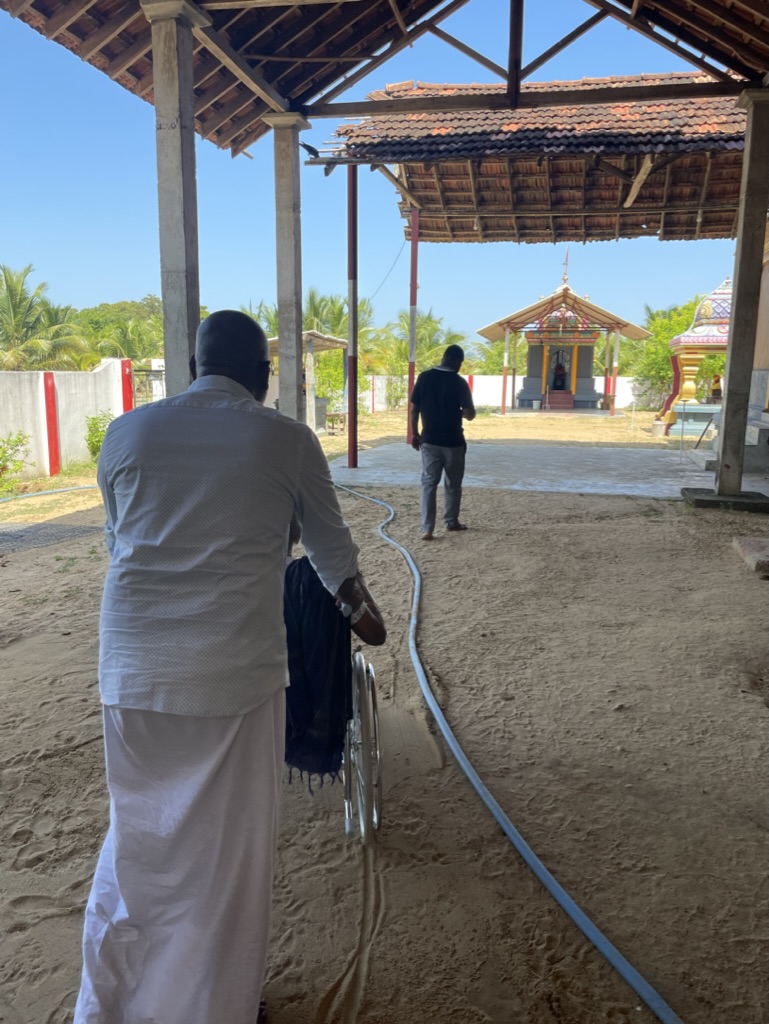
The looming towers and structures of the temple in Sivanagar were nearly knocked over by the impact of shelling. The slanted white bell tower outside the temple sank into the sand as my family members ran out of their homes to join the procession to Mullivaikkal. Today, reconstruction efforts led by the temple committee and funded by diaspora re-designed the temple into a much larger edifice. The destroyed bell tower was not replaced. For those who return and their families who carry these stories, memories of the bell tower’s sound marks more than a ritual time.
Just beyond the temple, near the quiet shade of an arasa maram (sacred fig tree), something more unsettling comes into view. A pile of red roof tiles sit to one side, cordoned off with thin lines of tape, as though both preserved and contained. At first glance, it is easy to mistake them for leftover materials, fragments of a project paused or abandoned. But their presence carries a heavier weight. These red bricks serve as a lasting reminder of the Sri Lankan state’s attempt to build a vihara on temple grounds in 2021, or rather its endeavour to capture and lay claim to land through cultural occupation.
Attempts to build a Buddhist vihara on the grounds of the temple were not halted by policy intervention or legal ruling, but by something quieter and more persistent; the refusal of locals to allow construction to begin at all. These stories of resistance rarely appear in official accounts, scholarship, or policy briefs. Much of what has been written about land colonisation and demographic engineering in Sri Lanka tends to focus on projects that have already taken shape, including militarised settlements, state-sponsored resettlement schemes, and large-scale development initiatives that transform landscapes and populations in visible, measurable ways. These studies offer important insights, but they often fix communities within a single moment of displacement, resettlement, or absorption into the machinery of the state. What is less easily documented are the forms of resistance that prevent state-sanctioned colonisation projects from materialising. In the lives of Sivanagar’s residents, the pervasive enforcement of the Sinhala-Buddhist state is felt at multiple scales. Insidious, covert, and strategic, the Sri Lankan state wields tools of Buddhisisation, militarisation, resettlement, and development to advance Sinhalisation in the Tamil North-East.
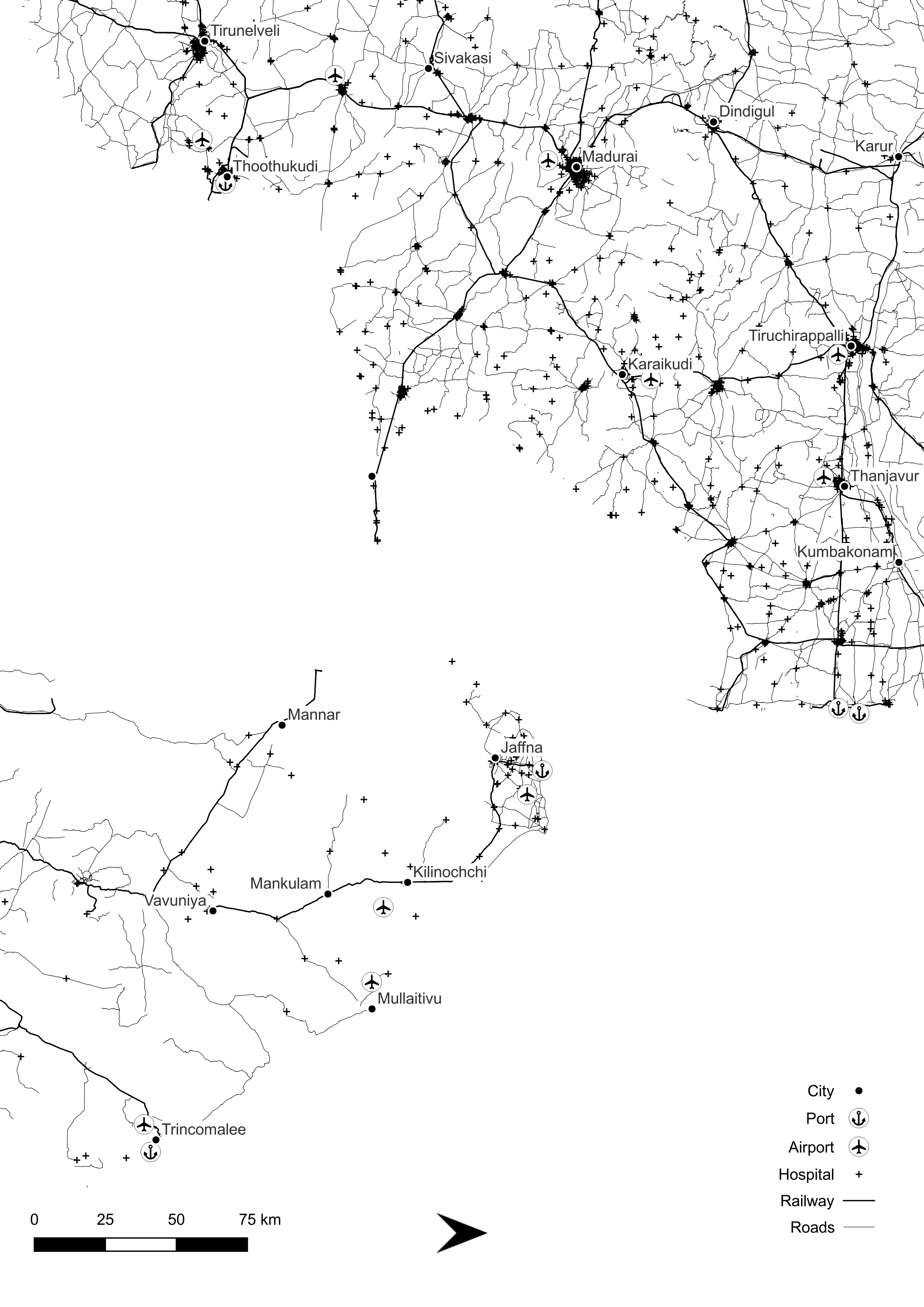
Sivanagar is a small village 30 minutes outside of Kilinochchi town. The drive from Colombo was 9 excruciating hours, during which it was impossible not to notice all the inconspicuous ways that the Sri Lankan state’s project of Sinhala-Buddhist ethno-nationalism extended into the North-East. The A9 highway connecting the south to the north ran through a series of small cities and villages. Along the road, every 5 miles or so, we would see a Buddha statue, so many that I started counting and lost count at 52. I wondered if locals ventured deep into the forest, near this highway with dangerously fast cars, trucks, and motorcycles, to perform rituals and pray to these deities.
In 2021, the Sri Lankan Department of Archeology and Sri Lankan military forces sectioned off a part of the land near the main Sivan temple in Sivanagar to erect a Buddhist vihara. State officials announced the discovery of the arasa maram, or as they know it, a bodhi tree, a prominent symbol of the Buddhist religion on temple grounds. Historically, this is the first step towards land occupation in a process termed “buddhisisation.” In the article “Destruction of Hindu Temples” published in the book Black July ’83: Indictment, M. Neminathan lists quantitative statistics of Sri Lanka’s assault against places of worship in the North-East in the 1990s, arguing that physical destruction was one of many tools used by the Sri Lankan state to annihilate the Tamil people. Among tactics ranging from desecrating sites of religious worship to shelling surrounding areas on auspicious days, state officials would also “discover” sacred fig trees and “forcibly remove Tamil residents in their thousands to refugee camps [to] settle Sinhala Buddhists in their place, offering armed protection and new amenities.”
Once a tree is identified or planted, signs are written in Sinhala and detail narratives of an exclusive Sinhala-Buddhist presence in the area. In Sivanagar, these signs referenced a government gazette issued in March 2016 which declared that the temple was located on a protected archeological site. According to an archaeological report from 1956, this site was once home to a stupa. The re-interpretation and selective use of these reports weaponise religious symbols to cement ideological and material frameworks of Sinhala-Buddhist supremacy and further facilitates the displacement of Tamils.
Outside the village, in Kilinochchi town, Sinhalese-Buddhist tourists are routinely bussed in from the South to tour viharas as part of a strategic tool for the state to normalize political occupation, establish land claims, and promote Sinhala-Buddhist-cultural hegemony of the island. These groups of tourists, identifiable by their white outfits for religious observation, are closely accompanied by uniformed military officers with guns. As the Sri Lankan military and Department of Archeology continued to post signs and release gazettes on Buddhist ruins in Sivanagar, locals started to fear the possibility of gradual displacement and re-settlement if plans to build the vihara materialised.
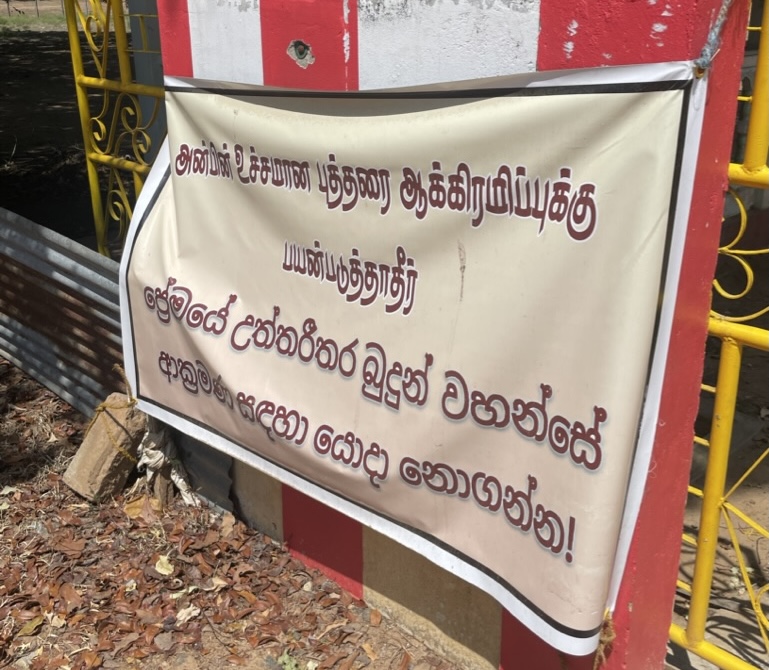
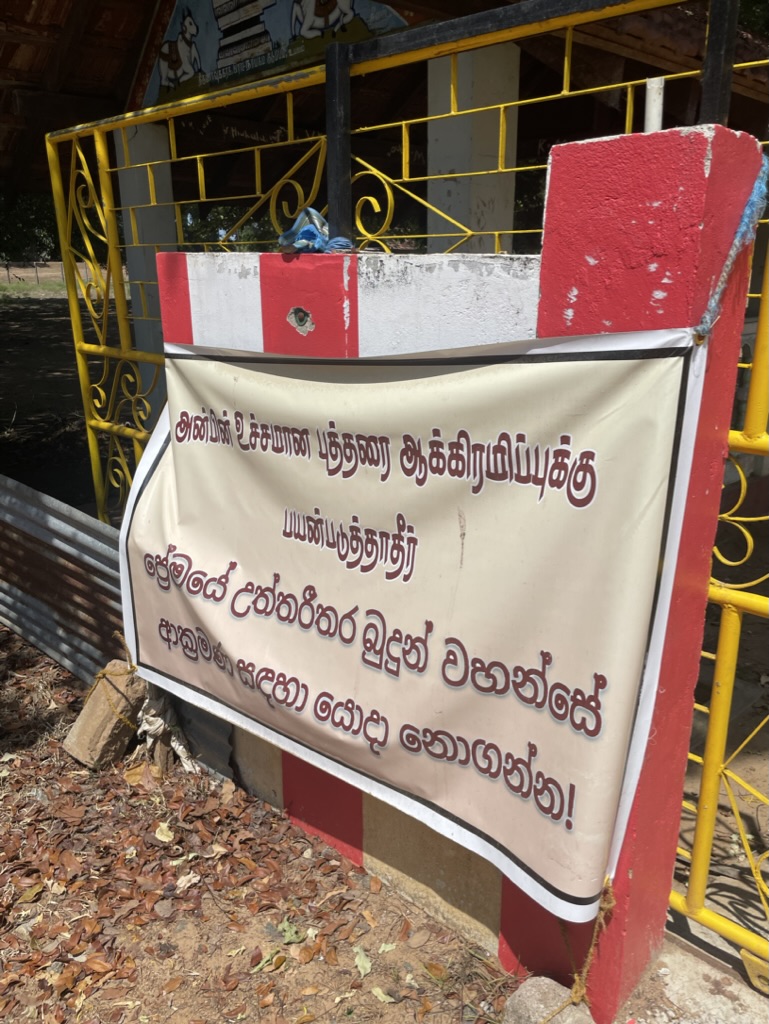
The Sivan temple is understood to be one of the oldest Siva-deity temples on the island, standing as a historical landmark that dates back several thousand years. Beyond its religious significance, the temple represents an important cultural and communal space for locals to convene. Following the Department of Archeology’s “discovery” of the bodhi tree, military officials moved truckloads of red tiles into the temple grounds with the objective of building a vihara. Locals refused to allow construction to begin, arguing that it was an attempt to implement the state’s land colonisation schemes and settle Sinhala communities in land customarily inhabited by Tamils. In an online article titled “Losing Heritage of Uruthirapuram Buddhist Ruins in Kilinochchi,” the author describes this act of collective refusal: “when the officers from the archaeological department arrived at the site, the pusari and the villagers refused access to the site.” In the summer of 2021, a committee of locals including elders, students, and representatives of the temple committee board, hung a large banner across the entrance gates with a message in both Tamil and Sinhala that roughly translates to: “Do not use the highest symbol of love, Buddha, to serve the purpose of destruction.”
While discussing Sivanagar villagers’ response to the Sri Lankan Department of Archeology and military’s attempt to build a vihara, my brother started telling me about the day all the villagers came together to protest the construction of the vihara. Someone had gotten word that the Archeology Department was coming in that day with protection from the military to officially begin construction, so villagers organised a time to meet at the temple. This was a rare feat, as there were many disagreements among locals, temple committee members, and students on how to properly address what was happening. Do we take this case to the courts? Do we take matters into our own hands? Upon arrival, everyone started a sit-in at the base of the temple, facing the group of soldiers that had assembled to provide protection to government officials who arrived to oversee construction. My brother recognised a young boy among the group of soldiers protecting the government officials and cautiously approached him, wondering why he would be defending the state as they tried to occupy his childhood temple. The boy turned to my brother and said “I’m sorry brother, I have no choice. I needed a job to feed my family, and this was the only place hiring.”
Normalisation of the military’s presence represents a much darker reality for Tamil and Tamil-speaking people in the North-East. Not only are Sinhala-Buddhist military officials participating in state-sanctioned colonisation, but an alarming number of Tamil recruits are now being brought into the fold of the Sinhala-Buddhist nation-building project. These Tamil recruits reflect a wider counter-insurgency strategy post-2009 where the Sri Lankan state offers military enrolment as the only solution to engineered poverty due to high unemployment and lack of local industry. In response to demands made by the International Monetary Fund to significantly reduce its defence spending budget, the Sri Lankan state instead chose to retrain security forces for policing and peacekeeping work or to work as rapid action teams for disaster response. This choice proves to be detrimental for Tamil and Tamil-speaking peoples in the North-East, who likely understand the presence of military officials to represent anything but peace.
In a 2011 article, Ambika Satkunanathan explains how every inhabitant of the Vanni region knows that their local Sri Lankan Affairs office must be informed if a handful of people want to gather and discuss a neighbourhood issue. In many of these cases, uniformed military personnel attended events to observe proceedings. While Satkunanathan’s description was written over a decade ago, the security situation in the Vanni region has not changed. Tamil remembrance activities to mark Maaverar Naal (Tamil Martyr’s Day) or Tamil Genocide Remembrance Day on May 18, continue to experience significant surveillance and intimidation from military and state officials, as organisers are subject to surveillance, harrasment, and arrest. In Sivanagar, while locals were well aware of the state’s plans to expand Sinhala settlements prior to the 2021 vihara construction plans, it was difficult to organise public gatherings on the issue without facing intense military surveillance. Nonetheless, resistance persisted in many forms, including in writing. One example is through a 2014 TamilNet article that described the “re-discovery” of Buddhist ruins in Sivanagar. The author foregrounds the Sri Lankan state’s intentions not in viewing, representing, and “protecting” the history of religions on the island, but rather in “creating a history in which people ‘reconcile’ with genocidal imperialism.”
The people of Sivanagar are no strangers to displacement. While locals were displaced several times in 2009, many families initially settled in Sivanagar to escape the arrival of military occupation in other villages. My grandparents arrived in Sivanagar from Vasavilan, Palaly, around the time that the Sri Lankan military forcibly displaced villagers in June 1990. The military seized homes, farmlands, markets, temples, and storefronts belonging to Tamils in Palaly and following 2009, demolished these structures to build large military complexes and training centers. For former residents of Palaly, return was impossible until recently, as access to the military compound and their destroyed homes was closed off to the public.
Sivanagar’s residents know the political, hegemonic, and violent processes of resettlement well. From independence to present-day, the Sri Lankan state and military builds and executes large-scale development projects and settlement schemes that drastically change ethnic composition and ratios in the North-East. Nearly 20 years prior to the Sri Lankan state’s attempts to occupy a temple in Sivanagar, Anton Balasingham in War and Peace identifies how Sinhalese villagers were actively recruited by the state to settle in areas where landless Tamil peasantry cultivated tiny plots of land, a state-sanctioned project of colonisation aimed at “reduc[ing] the Tamils to a minority in their own historical lands.”
These land colonisation and population settlement schemes are shaped by an increase in Sri Lankan military presence in the post-war North-East. In September 2024, the army’s Jaffna headquarters ran a beauty culture workshop in Kilinochchi. According to their official website, this workshop was done as a “gesture of goodwill” and to “build stronger community ties.” These words read meaningless against the backdrop of a larger counterinsurgency campaign that crafted these military-run workshops as a form of surveillance over young people growing up under occupation. On their social media and official website, the Security Forces Headquarters proudly featured photos of female attendees with their certificates of completion standing behind a row of seated male uniformed military officials. This is only one example of the countless intrusions of military personnel into schools, community centers, places of religious worship, and other areas where Tamils and Tamil-speaking people convene in Kilinochchi. The Sri Lankan Army effectively embeds itself in civilian affairs, routinely appearing in schools for prize-giving, sponsoring sports-meets, running workshops for unemployed youth, and during the 2022 economic crisis, through distributing food and aid packages. Military officials also make routine appearances accompanying and protecting Department of Archaeology officials as they front-run land grabs.
High representation of military officials in the daily lives of civilians in the North-East represent the latest iteration of Sinhala-Buddhist imperialist expansion enabled through militarised development. Thiruni Kelegama studies development initiatives in the North-East and identifies how the Sri Lankan military sets up base camps in major cities, surrounded by a system of satellite camps, military cantonments, and clusters of homes in villages nearby to employ and eventually settle entire military families. In this way, the military plays an active role in the Sri Lankan state’s demographic engineering project aimed at re-settling Sinhalese settlers into Tamil villages through the normalisation of its presence in the political, economic, and social livelihoods of villagers.
Following 2009, the military’s encroachment on civilian lives in Sivanagar took on a more sinister, psychological approach, by occupying areas that represented significant historical landmarks for locals. After the brutal end of the war, the Sri Lankan military set-up a satellite camp and checkpoint in Sivanagar near a bridge that sat across from the main marketplace. The deliberate choice to build a military checkpoint in this location elicited memories of successive Sri Lankan military helicopter attacks dating back several decades. In 1991, military helicopters targeted a group of nine schoolchildren in the same area and repeatedly shelled the bridge that they were hiding under, killing everyone. This bridge continued to withstand the brunt of successive bombings and military attacks up to 2009. The land near the bridge once housed the Women’s Front headquarters of the resistance and Sivanagar was an important location for the training of female cadres. The choice to build a satellite camp in the same location was meant to serve as a historical reminder of the gruesome violence the Sri Lankan state was capable of inflicting on Tamil people and to physically replace memories of the resistance. In a village where the locals were used to having their daughters protect them, many spoke to the dismembered feeling of having to walk past a military checkpoint in order to make it to the marketplace or temple. A gruelling reminder of genocides, past and present.
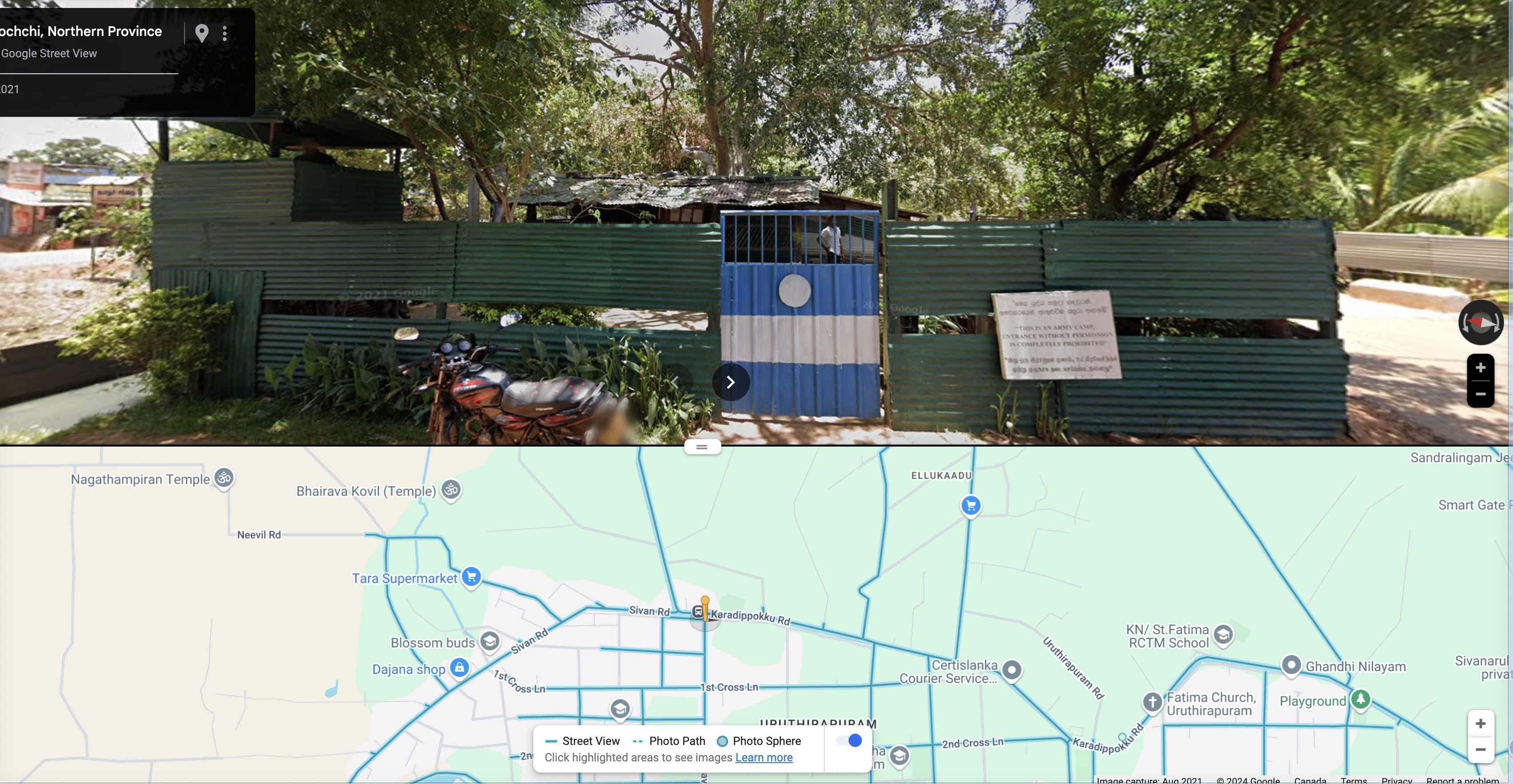
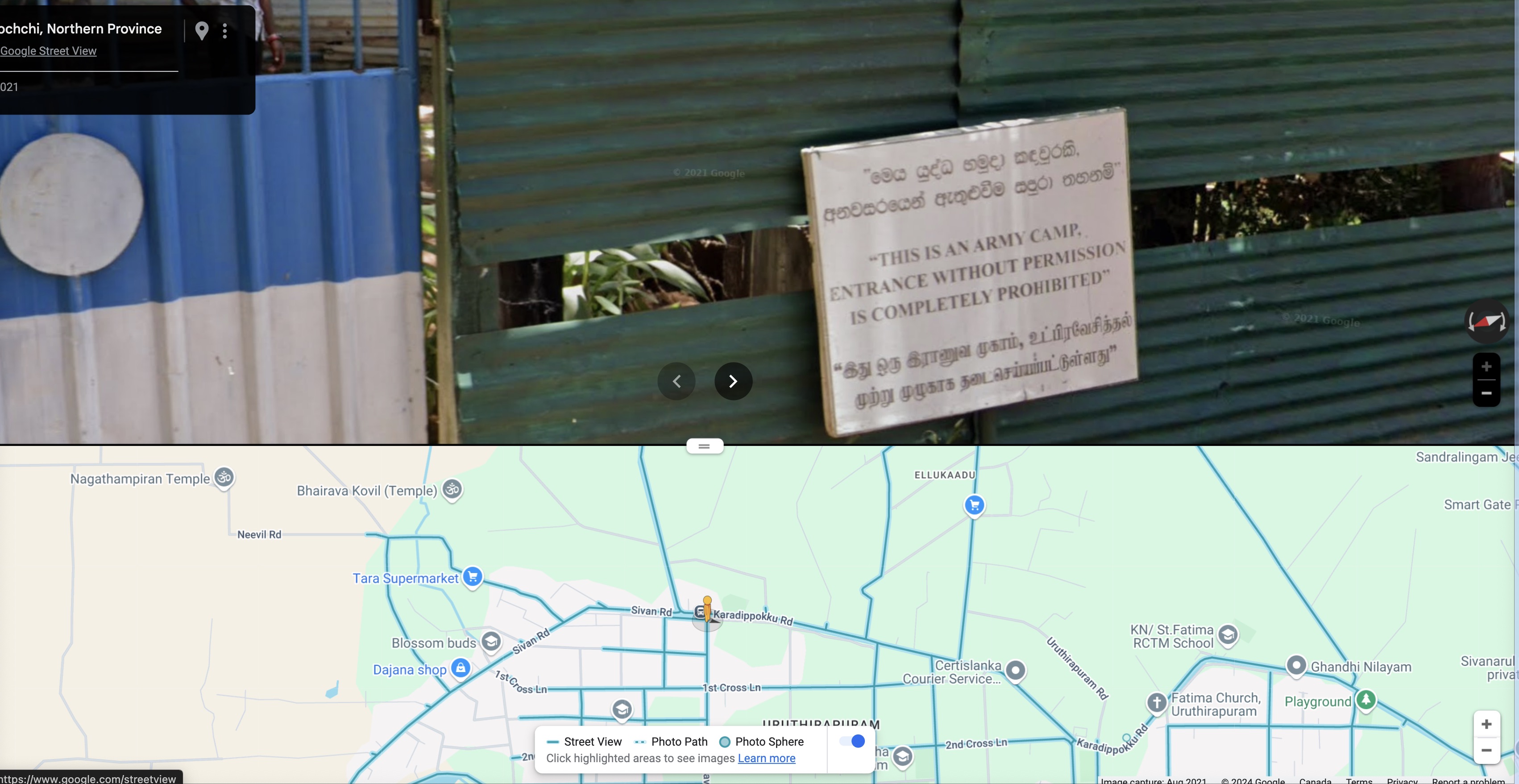
Surveillance, occupation, and development projects are linked through complex security networks rooted in Sinhala-Buddhist ethno-supremacy. In January 2023, the Sivanagar satellite camp was dismantled following requirements by the International Monetary Fund (IMF) for Sri Lanka to significantly reduce its defense spending and troop numbers in order to receive a $2.9 billion aid package. Dismantling an army satellite camp did not ensure peace for villagers of Sivanagar who continue to refuse entry to Department of Archeology officials to build a vihara on temple grounds. In 2024, Thiruni Kelegama published a study on Ranavispura, a military camp located in the heart of Manal Aaru (Weli Oya) that houses Sinhalese military and settler families. Manal Aaru is a site of the state’s largest demographic engineering project, the Mahaweli Development Project. It represents an important frontline for the Sri Lankan state in the use of satellite camps to entrench the military’s presence. Development projects transform military personnel into “protectors” and “heroes” based on symbolic, ideological, and mythical claims rooted in Sinhala-Buddhist ethno-nationalism. This transforms the perception of military personnel from settlers and occupiers to localized, rational agents, normalising the military within the public imagination. The Sri Lankan state continues to actively merge the lives of military and civilians with the sole purpose of growing a Sinhala population in Manal Aaru. However, armed protection is only offered to settlers and not to the Tamils whose existence, despite settler incursion, challenges attempts at occupation.
The state constructs and executes population re-settlement schemes in Tamil areas to consolidate Sinhala-Buddhist ethno-nationalism and displace Tamil and Tamil-speaking peoples by observing, supervising, and eventually removing them. Stories of transformation are widespread, with the demographic, linguistic, and ethnic composition of entire villages changing over the course of one generation. In this environment of rapid occupation and transformation, where Manal Aaru represents a frontline for the Sri Lankan state, Sivanagar represents an interruption. When acts of defiance disrupt the state’s mechanical operation of colonisation, it is worth pausing to consider how people organise against the Sri Lankan state’s machinery of occupation and dispossession through collective refusal.
On returning to Sivanagar, sharing a meal, tea, and asking one-too-many questions to elders, students, and community members, I understood that their overlapping and fractured accounts of protest against the vihara repeatedly gave way to memories of war. How community members spoke about land, belonging, and loss in relationship to this temple surfaced in their memories of genocide and displacement. In one afternoon visit, a temple committee member and former postman pulled out an old ledger. The yellowed pages were filled with careful entries, letters received, money orders, names of senders and recipients. He explained that during the war and in the midst of shelling and aerial bombardment, he had kept these records with precision, ensuring that each message reached the intended recipient. The ledger was an important way of tracking who was still alive and who had passed in the last months of genocide, when statistics, NGO workers, and the outside world had left his people to die.
There were only a few systems left to rely on, and the ledger became one of them. Any conversation around land and occupation always took us back to how previous generations were in relationship to the land, how it changed during the years of the de facto state, and how these transformations live on in memory. The temple remains as one of the few places that Sivanagar locals, family members and displaced peoples continue returning to as a part of their daily life.
Occupation does not only take a conventional form of sheer military presence, as it manifests differently across parts of the North-East. Sivanagar locals are well-aware of on-going cases of Sri Lankan state ethno-nationalist occupation projects across the North-East and how these cases serve as a blueprint for what may come to them. In recent years, the ongoing land struggle in Thayiddy, a village where Tamil residents continue to protest the illegal construction of a vihara on their stolen land, represents a dire reality for Tamil and Tamil-speaking people in the North-East. State authorities demand proof of residence from Thayiddy residents to return the stolen land on which a buddhist vihara has already been built. Decades of war and displacement left many residents without formal documents to prove residence, acting as another bureaucratic barrier to advance occupation. Community documents, such as the ledger, represent a lasting defense used by Tamil people to repeatedly assert their pre-existing and ongoing relationship to land, that which cannot be easily usurped into the state’s attempt at occupation.
Today, the ledger resembles an archive, one of the only remaining ways to trace who was killed, who was forcibly disappeared, and who never returned. In Sivanagar, disappearance is not confined to people or the past. It represents a point of departure, a way of understanding the present, and a reminder to refuse further erasure. While the Sri Lankan military and Department of Archeology’s physical presence might be a distant reminder of the past, locals are quick to remind us that it is only a matter of time before they try to build the vihara again. And when they do, residents will be organised and ready to refuse. By paying close attention to the insidious process of Sinhalisation on the island, we can locate how power operates to freeze the Tamil people in a period of loss, rather than a people rooted in ongoing resistance and refusal to occupation and colonisation.
In Sivanagar, stories of resistance cannot be easily distilled into a single, coherent narrative. Nor should they be. The area surrounding the temple, once a luscious forest of trees and shade, now stands dry and shell-ridden, a lasting reminder of how close the state got to destroying all life in this village. Sivanagar’s story is not simply about people fighting to protect a temple. This is a story about fighting to protect Tamil peoples’ customary relationships to land, and the locals’ continued resistance, whether it be in writing, action, or whispered accounts, to the Sri Lankan states’ attempt to colonise and re-settle the North-East.